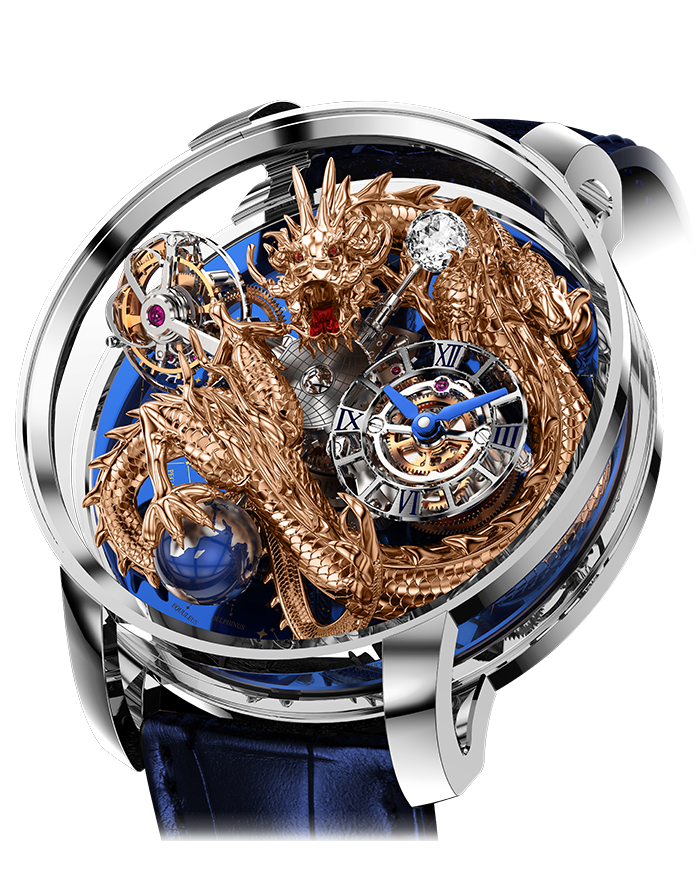
Jacob & Co. Astronomy Revolution
Top-notch aesthetics and an impressive design.
high quality watches replica
Jacob & Co., traditionally known for its top-of-the-line jewelry watches and grand complications, recently introduced a very typical Jacob watch, but surprisingly new mechanically. The Astronomia Revolution stuck to the distinctive oversized shape that defined the model, but included an entirely new movement that combined multiple complex components into an even more complex movement, all under the name of a dynamic, rapidly rotating display.
The merry-go-round with its tourbillon and time display is astonishingly fast, completing one revolution per minute, a feat achieved by a sixth-of-a-second constant force mechanism and time display differential. The dynamic nature of the dial means it is unlike any other mechanical
replica luxury watches.
The Astronomical Revolution was included in the list of notable complications I unveiled at Watches & Wonders earlier this year:
"The Revolution appears to be another variant of the New York jeweler's best-selling ball timepiece...but that's not the case...whereas past versions of the Astronomia would have taken 10 to 20 minutes or more to complete a turn of the merry-go-round, the Revolution does it in a minute, [and] has a minute hand. Moving such a large part at that speed is unprecedented..."
That pretty much sums it up. It looks like a typical Jacob & Co. watch, but is more interesting mechanically. This is because the movement goes against the prevailing conventions of movement building. The physics of a mechanical movement dictates that time display elements are either large and slow-moving, like Urwerk's rotating cube, or light and fast-moving, like the lightning second chronograph.
replica watches for sale
The Astronomia Revolution manages to propel the massive and heavy time display consisting of a central carousel at a relatively high speed of one revolution per minute. This is probably the only watch that has such a large time display component and moves at this speed.
The fundamentals of the movement are simple but challenging to execute, which explains why it hasn't been done before. Maintaining a balance of key aspects of movement, namely the energy required, the rate at which energy is released, and the complex movement itself is a commendable achievement. As expected, the movement was developed by Concepto, a complication specialist known for its technical prowess.
The kinematics do have some drawbacks, most notably the visible movement of the turntable. It makes one full revolution per second, but its speed of rotation is so small that it can be seen when looking closely. This is the result of charging and releasing a constant force every sixth of a second, but causes the turntable to wobble slightly.
replica watches Price
Then there are sizes and styles. By Astronomia standards, the Astronomia Revolution is small, but still a massive watch. As much as I love it, the luxurious design may not be for everyone. The design manages to retain the exaggerated spirit of Jacob & Co. while being slightly more restrained than most of the brand's offerings, some of which feature tarantulas, dragons and Don Vito Corleone.
In absolute terms, this watch is very expensive, but as far as watches and others like it are concerned, it is fair. In the specific watchmaking market that Jacob & Co. occupies, the prices of the Astronomia Revolution are quite reasonable compared with the likes of Richard Mille and Hublot.
rich design
The design of the Astronomia Revolution is a combination of sci-fi and sparkle. The case measures 47mm x 27mm, which means it's almost half as tall as it is wide at its thickest point.
It's big, but doesn't feel huge for its size, thanks to the vented case, which is almost all sapphire crystal, and the short, downward-sloping lugs. In other words, it fits surprisingly well on the wrist for a 47mm watch, but it's still a 47mm
Review replica watches.
The dial base is composed of hexagonal 18K red gold panels, inspired by the gold-plated mirror in the James Webb Space Telescope. These panels mimic the mirrors of a telescope, but on a smaller scale. As with the telescope, the panels number 18 and are similarly arranged in a gentle bowl shape.
Despite their reflective nature, these panels actually give the watch a clean geometric aesthetic, especially compared to the crowded surfaces of other Astronomia models. The connection between space telescopes and astronomy is slight at best, but it still looks pretty cool.
and ingenious mechanisms
Even more interesting than the multitude of elements that make up the dial is how they work. The basic premise of the astronomical revolution is the same as that of the astronomical models of the past. The central turntable rotates on its own axis and hosts various complications via extension arms.
Unlike most Astronomia movements, which have symmetrical arms, the Astronomia Revolution has three arms that make one revolution per minute clockwise. One has a ruby-arrowed second hand at the tip, another has a time display, and the last is a tourbillon.
An arrow-shaped synthetic ruby acts as the seconds hand, making one revolution around the dial every minute, but it also makes one revolution on its own axis every 15 seconds.
Color-coordinated with the ruby arrows, the time subdial is a red polycarbonate skeletonized disc. The red sub-dial turns around the dial once every minute, but it must remain upright throughout the movement to display the correct time. Supporting its fixed position are differential gears that constantly turn the sub-dial counterclockwise once per minute. In other words, the sub-dials travel in the opposite direction to the dial, but at the same speed.
The most complex part of the merry-go-round is the tourbillon, which itself is bi-axial but technically a triple-axis setup.
replica JACOB & CO ASTRONOMIA
The tourbillon cage, in the form of the Jacob & Co. logo, rotates on its own axis every minute. Additionally, the carriage rotates around its transverse axis every 15 seconds because it is driven by the same gear train that turns the ruby arrow at the same speed. But the one-minute track of the merry-go-round gives the tourbillon a third axis of rotation, making it a three-axis tourbillon.
On their own, the various mechanisms such as the tourbillon and differential drive time display are familiar, but the speed at which they operate is both unexpected and impressive. Despite its considerable weight, the dial makes one revolution around the dial every minute. All previous movements with such complex components, such as the Ulysse Freak or the Astrotourbillon by Cartier, usually only make one revolution per hour, a speed that is indistinguishable to the naked eye.
Jacob & Co. managed to deliver a 10-minute revolution in past models like the Astronomia Maestro, but the 10-minute cycles were still slow enough that watching the carousel move was tedious. The Astronomia Revolution, by contrast, has a vibrant display and is also intuitive since the carousel doubles as the seconds hand.
Powering the heavy merry-go-round required a pair of mainsprings (each longer than an average human height) located below the dial, but the enormous energy generated by the mainsprings required a regulated rate of release, requiring a constant-force mechanism.
The constant force mechanism is integrated in the tourbillon, also known as the constant force mechanism, which consists of a miniature spring mounted coaxially with the wheel. This mainspring winds the mainspring and releases it immediately every sixth of a second, providing the power that drives the tourbillon and rotor. Although the design of the constant force mechanism is simple, it is effective and is notable for its size - there are very few oscillating weights compact enough to fit in a watch tourbillon.
The use of a galvanometer and the resulting gradual release of energy results in a corresponding stepwise movement of the turntable. Since the oscillating weight works on a six-sixth-of-a-second cycle, this cannot really be seen with the naked eye, but it can be seen that the movement of the dial is not as smooth as that of a traditional 4 Hz moving seconds hand.
In the long run, the enormous power generated by the twin barrels and the many gears required to run the dials can create more friction and thus more wear. At least in theory, this would lead to shorter maintenance intervals. In practice, I expect the service intervals to remain the same, as such watches are rarely worn often or regularly for long periods of time.
In some respects, the Astronomia Revolution movement is reminiscent of a very different watch from a very different brand, the Lange 31 from Lange & Söhne.
www.reviewluxurystore.com[/b]
The Lange 31 also has a pair of equally long mainsprings, which provide a power reserve of 31 days. In comparison, the Astronomia Revolution has a power reserve of just 36 hours, because it takes a lot of power to move the carousel. Like the Astronomia Revolution, the Lange 31 required an oscillating weight to handle the energy stored in the mainspring, but Lange's constant force mechanism was mounted between the mainspring and the escapement.
While a watch like the Astronomia Revolution is all about design, complications and visual presentation, its movements are decorated in an industrial haute horlogerie fashion, with machine-applied decorations and hand-finished touches. There are a large number of visible components, and most are handled appropriately. For example, the underside of the tourbillon cage is satin-brushed, chamfered and countersinked.
The material of the subdials is the only element of the watch that feels out of place. Although polycarbonate is a high-strength plastic and can be shaped beautifully, it just doesn't feel right for a watch at this price. It would certainly be better to use transparent sapphire subdials, albeit at a higher cost, or simply use anodized aluminum, which is economical and light.
The Astronomia Revolution looks like another Astronomia watch (and there have been plenty of them), but it's actually a surprisingly interesting watch. Together with Concepto, Jacob & Co. have managed to create a movement with an impressive level of engineering and equally impressive visual performance.
More importantly, the entire watch is coherent from design to complex functions to touch. It's overdone, too much, but also smart, just right.
Jacob & Co Astronomia Casino
Jacob & Co. Astronomy Revolution
Ref. AT170.40.AB.AB. Abruja
Diameter: 47 mm
Height: 27mm
Material: 18k Rose Gold
Crystal: Sapphire
Water resistance: 30 m
Movement: JCAM48B
Functions: Hours, minutes, rotating arrow seconds indicator, constant force mechanism and biaxial tourbillon
Winding: manual winding
Frequency: 21,600 beats per hour (3 Hz)
Power reserve: 36 hours
Strap: Cordura fabric with folding clasp